HMO management
Bills-Included HMO: How to Set a Fair-Usage Cap and Bill the Excess
· 12 min read
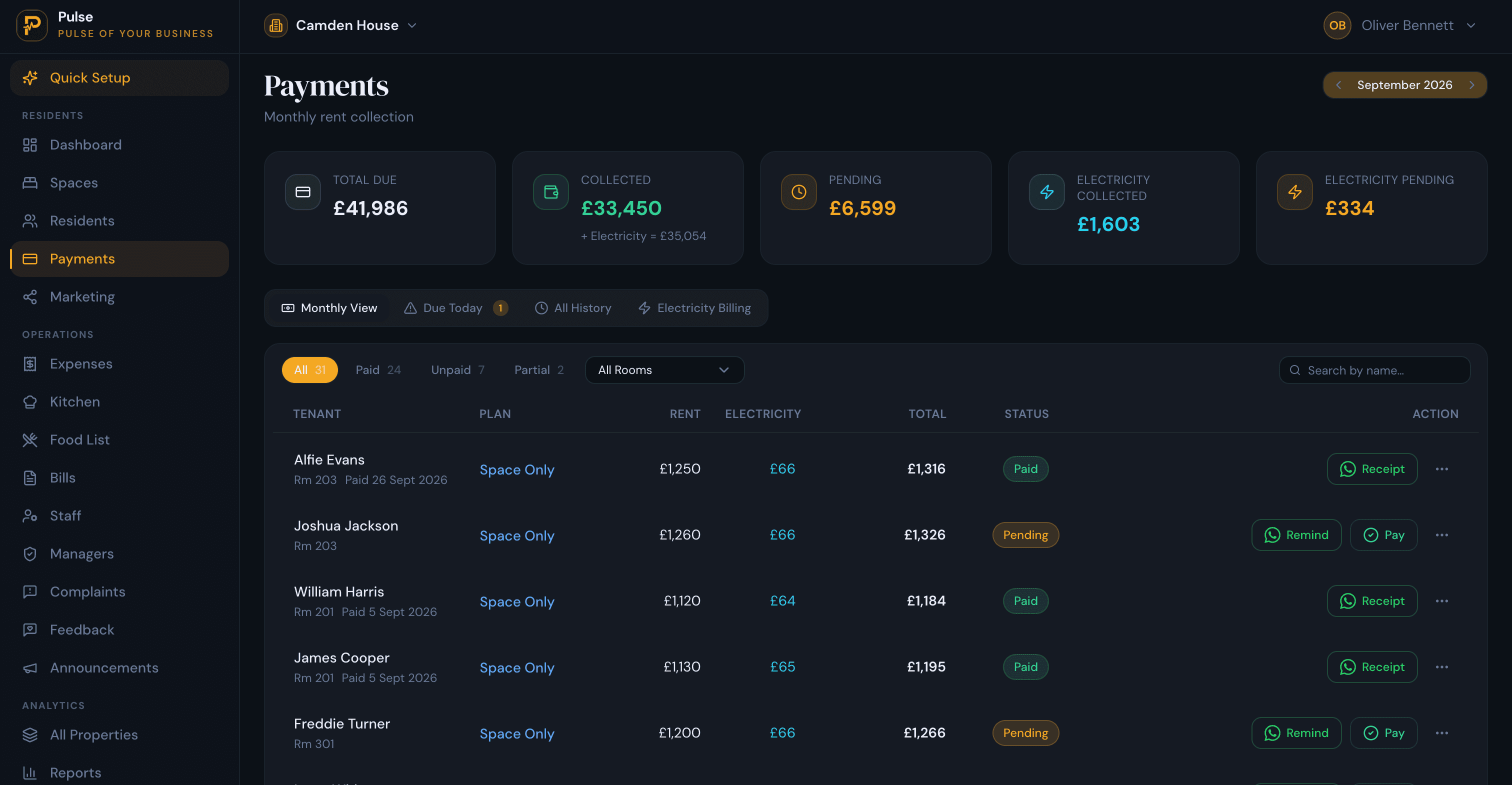
Bills-included rent is what fills rooms in a professional HMO. It is also what keeps HMO landlords awake when energy prices jump, because the tenant has no reason to turn anything off and you are holding the bill. A fair-usage cap is how you share that risk: energy is included up to a sensible level, and beyond it the tenants cover the extra at your cost. Done well, it protects your margin and nudges people away from leaving the heating on with the windows open. Done badly, with a cash cap or a vague clause, it causes arguments and, if you try to profit from it, breaks the law.
This guide sets out how to do it properly: the one rule that limits what you can charge, how to set the allowance, a worked example with real numbers, how to measure and bill the excess, the clause wording, and how to handle a tenant who leaves mid-period. It is general information for UK landlords, not legal advice.
What a fair-usage cap actually is
In a bills-included HMO, the rent covers energy up to a reasonable amount of use. The fair-usage cap, or fair-usage policy, is the line that says where reasonable ends. Below it, the tenant pays nothing extra. Above it, the tenants between them cover the cost of the additional units. It is not a second rent and it is not a profit centre. It is a way to recover your cost when a house burns through far more energy than you priced the rent around, and to give tenants a reason to care about waste they would otherwise never see.
The one rule that caps what you can charge
Before you set a single number, understand the limit. If you resell gas or electricity to your tenants, you are bound by Ofgem’s Maximum Resale Price rules. A genuinely all-inclusive rent with no separate energy charge sits outside this, but the moment you itemise and bill tenants for units over an allowance, you are reselling energy and the rules apply. In plain terms, you cannot charge more than you paid: the most you can recover is the price per unit your supplier charges you, plus a fair share of the standing charge. You are not allowed to make a profit on energy you resell to tenants.
That single rule shapes everything else. A fair-usage charge is cost recovery for the units used over the allowance, billed at your supplier’s rate, with the bill as evidence. It is never a mark-up, a flat penalty, or a round number you picked. Build the clause and the maths around cost, and you stay on the right side of the rule. This is general information, not legal advice, so confirm the current position with Ofgem or a solicitor before you rely on it.
Set the cap in units, not pounds
The most common mistake is a cash cap: energy is included up to, say, 150 pounds a month. It feels simple and it falls apart immediately. When unit prices rise, that 150 pounds buys fewer units, so a tenant who did nothing differently suddenly owes money. When prices fall, a tenant can waste energy and still sit under the cap. A cash cap also sits awkwardly with the cost-only rule, because the number was never tied to what you actually pay.
Set the allowance in kilowatt-hours instead. A unit allowance tracks real use, it does not move when tariffs move, and it maps straight onto cost recovery: the excess is simply the units over the allowance, charged at the rate you pay. Hold the allowance in units and let the price be whatever your bill says on the day.
How to set a fair allowance
The number that matters most is the property’s own history. Pull the last twelve months of meter readings, or your annual statements, and you have a real baseline for how much this house uses with normal occupancy. Set the allowance at, or a little above, that baseline. Nothing beats real data from the actual building.
If you do not have a full year yet, start from a benchmark and adjust. Ofgem publishes typical domestic consumption values for a single home: as of its 2026 review, a medium-use home is around 2,500 kWh of electricity and 9,500 kWh of gas a year (check Ofgem for the current figures, as they are reviewed). An HMO with several occupants uses more than one home, but not in a straight line per head, because kitchens, hallways, boilers and routers are shared. Use the single-home figure as a floor, scale it for the number of occupants and the shared space, and lean on the property’s meters as soon as you have a few quarters of readings.
Two adjustments catch people out. First, seasonality: a flat monthly allowance punishes winter and rewards summer, so either set the allowance over the whole year or the tenancy, or vary it by season. Second, the make-up of the house: electric heating, a hot-tub, or a house full of gamers changes the baseline, and the fair number is the one you can evidence for that property, not a figure from a forum.
A worked example
Numbers make this concrete. Take a five-bed HMO on a single electricity meter, billed quarterly.
Worked example, electricity
1. Baseline from history. Last year the property used 5,400 kWh of electricity. That is your evidence-based baseline, well above a single medium home (2,500 kWh) because five people share it.
2. Set the allowance. 5,400 kWh a year is 1,350 kWh a quarter. Set the fair-usage allowance for the quarter at 1,350 kWh for the whole property.
3. Read the meter. Opening reading at the start of the quarter, closing reading at the end, both dated and photographed. This quarter the house used 1,620 kWh.
4. Find the excess. 1,620 used minus 1,350 allowed is 270 kWh over.
5. Price it at your cost. Your supplier charges you 24.5p per kWh. The excess costs 270 × 0.245 = 66.15 pounds. That is the whole charge: no mark-up, and the standing charge stays out of it because it is fixed and already covered by the rent.
6. Share it fairly. If all five tenants were in for the full quarter, that is 13.23 pounds each. Send the figure with a copy of the supplier’s bill so everyone can see the rate.
Notice what the cap is doing. It is not making you money; the 66.15 pounds is exactly what the extra units cost you. It is protecting the rent you set and giving the house a reason to not run the immersion heater around the clock.
How to measure it
The charge is only as strong as the evidence behind it. Take meter readings at the start and end of every period, date them, and photograph the meter so there is no dispute about the figures. A smart meter makes this easier and gives you a usage trail, but it is not required. Keep your own supplier bills, because they are what prove the rate you are allowed to pass on.
One limit is worth naming: a single property meter tells you the total, not who used what. That is why a whole-property excess is split across tenants rather than pinned on one room. If you want to bill a room for its own usage, you need per-room sub-metering, which changes the whole approach, as we come to below.
On the bill
Whatever method you use, the excess should land on a clear statement next to the rent, with the units, the rate and the split shown, and the supplier’s bill attached. PulseHub, for example, puts metered charges on the same monthly bill as rent so a resident sees one balance rather than a surprise invoice.
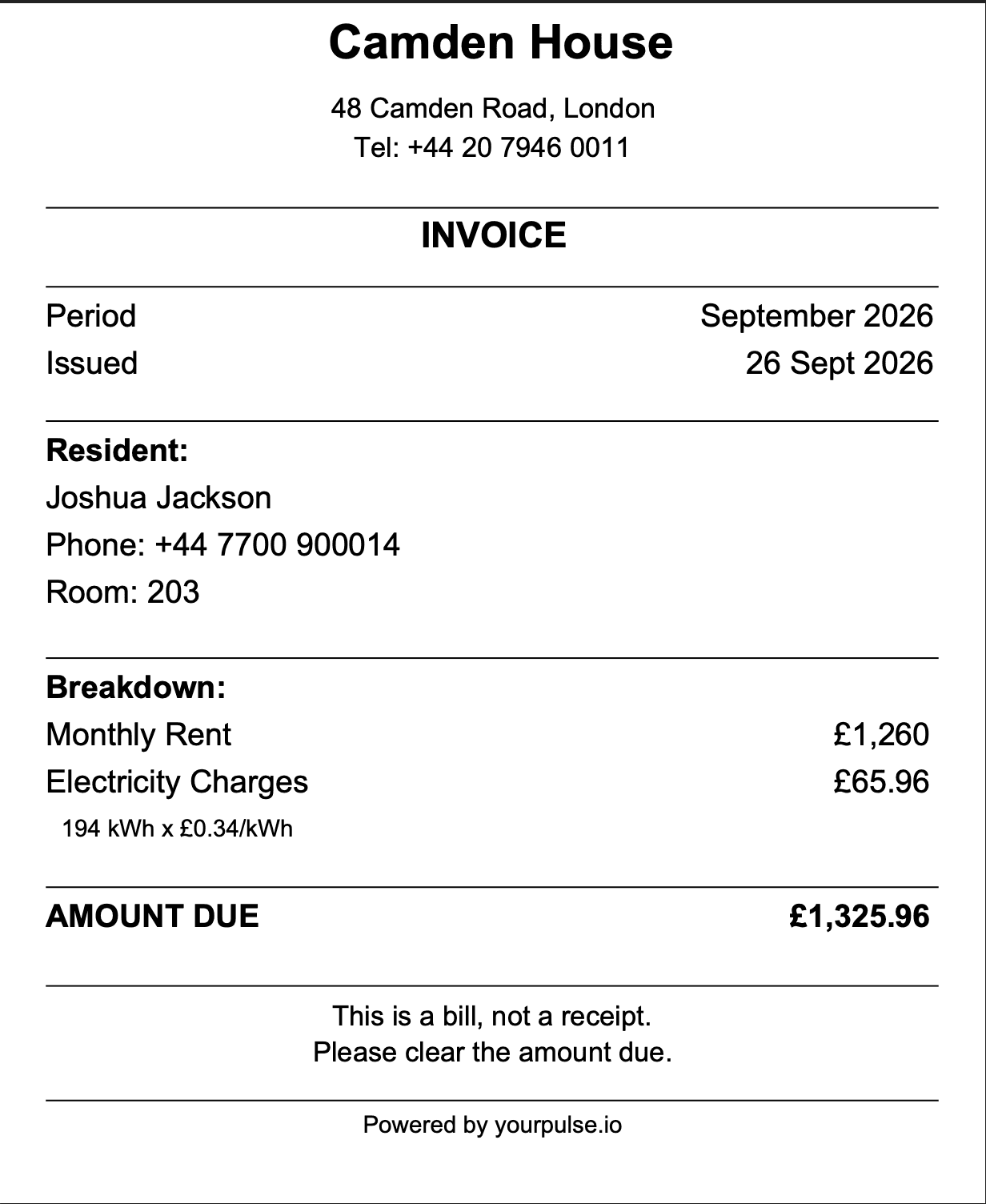
Rent and metered electricity on one bill
Billing the excess, and splitting it fairly
Charge the excess units at your supplier’s rate and no more. That keeps you inside the resale rule. For the split, the fairest method is by occupied days: work out how many tenant-days each room contributed to the period and divide the excess in proportion. When everyone was present for the whole period that collapses to an equal split, which is why an equal split looks fine until someone moves in or out.
Resist two temptations. Do not fold the standing charge into the excess, because it is fixed and already in the rent. And do not reach for the deposit: energy overuse is a cost to bill with evidence, not a deposit deduction, and deposit schemes rarely back a vague fair-usage claim. Bill it openly, with the numbers and the supplier’s bill, and it holds up.
The tenant who leaves mid-period
This is the case the 500-word guides skip, and the one that causes the most friction. If a tenant moves out a third of the way through the quarter, they did not have use of the house for the other two thirds, so they should not carry a full share of an allowance or an excess that built up after they left. Pro-rate it: each tenant’s share of both the allowance and the excess follows the days they occupied a room in the period, and a replacement tenant picks up from their move-in date.
Doing that by hand across rooms and dates is exactly where fair-usage policies become a chore, and where the maths quietly goes wrong. Software that already holds each resident’s move-in date can split a metered charge between them automatically, instead of you working out tenant-days on paper. Our guide to tracking HMO rent, payments and arrears covers the same discipline for the rent itself.
Example fair-usage clause
A fair-usage charge is only enforceable if it is written into the tenancy, clearly and fairly, and agreed by the tenants before they sign. The wording below is an example of the elements a fair clause covers. It is not legal advice and not a template to copy blindly: have it checked by a solicitor or your redress scheme, and make sure it matches how you actually bill.
Example wording only, not legal advice
Electricity and gas are included in the rent up to a fair-usage allowance of [X] kWh of electricity and [Y] kWh of gas per [period] for the whole property, measured by meter readings taken and recorded at the start and end of each [period].
If usage exceeds the allowance, the tenants will together pay for the excess units at the landlord’s own cost per unit, being the rate the landlord’s supplier charges, with no mark-up and on production of the supplier’s bill. The standing charge is not part of this charge.
The excess is shared between the tenants in proportion to the days each occupied a room during the [period]. The allowance is expressed in units, not as a cash cap, and the landlord will not make a profit on resold energy.
A cleaner way: bill metered usage, not a blunt cap
A cap is a workaround for not knowing who used what. The moment you can meter rooms, the fairer answer is to stop capping and simply bill each resident for their actual share. This is how PulseHub handles HMO utilities: you record a meter reading, it is priced against your tariff, and it is split between residents by their join dates, on the same monthly bill as the rent. Everyone pays their real share at your cost, so there is no cap to argue about, no cash limit to revise when prices move, and the resale rule is satisfied because the charge is your cost and nothing more.
Whether you run a formal allowance or bill metered usage directly, the hard part is the bookkeeping: readings, rates, who occupied which room and when, and a clear line on every resident’s statement. Across several HMOs that is more than a spreadsheet wants to hold, which is the same reason landlords move rent tracking off Excel. See our guide to managing multiple HMO properties without spreadsheets.
Run your HMO utilities the fair way
Fair usage only works if it is fair in both directions: you recover your real cost, tenants pay for what they actually use, and both sides can see the figures. PulseHub keeps rooms, residents, rent and metered utilities on one platform, splits charges by occupancy, and puts them on a single bill per resident, in pounds. See HMO management software, or start a free trial and set up your first property in minutes.
Frequently asked questions
Can I charge tenants more than I pay for their energy?
No. Under Ofgem’s Maximum Resale Price rules, if you resell gas or electricity to tenants you cannot charge more than you paid per unit, plus a fair share of the standing charge. A fair-usage charge recovers your cost for the extra units, it is not a profit. This is general information, not legal advice; check the current rules with Ofgem.
Should the fair-usage cap be in units or in pounds?
Units (kWh). A cash cap breaks the moment energy prices move: a tenant can blow through a pound cap without using more, or stay under it while wasting energy. A unit allowance tracks real use, survives price changes, and maps cleanly onto the cost-only rule, because you charge the excess units at the rate your supplier charges you.
What if a tenant leaves part-way through a billing period?
Pro-rate it. Work out each tenant’s share of the allowance and of any excess by the number of days they occupied a room in the period, and let a replacement tenant pick up from their move-in date. A flat split is simpler but unfair once people come and go mid-period.
Can I keep part of the deposit when someone exceeds fair usage?
Treat energy overuse as a cost to recover with the supplier’s bill as evidence, not as a deposit deduction. Deposit disputes over fair usage are hard to win unless the tenancy clearly allows it and your figures are evidenced. Billing the excess at cost, separately and transparently, is cleaner and more defensible.
Is a fair-usage clause legal in a bills-included tenancy?
It can be, if it is written into the tenancy, worded clearly and fairly, agreed by the tenants, and the charges never exceed your actual cost per unit. A vague or one-sided clause, or any attempt to profit, is what gets challenged. This is general information, not legal advice; have your clause checked by a solicitor or your redress scheme.
Do I need a smart meter or sub-meters to do this?
No, but you do need evidence. At a minimum, take and photograph meter readings at the start and end of each period. A smart meter makes readings easier. Per-room sub-meters go further: they let you bill each room for its own actual usage rather than splitting a whole-property excess.