Comparisons
Best Dormitory and Bedspace Management Software in the Philippines (2026)
· 9 min read
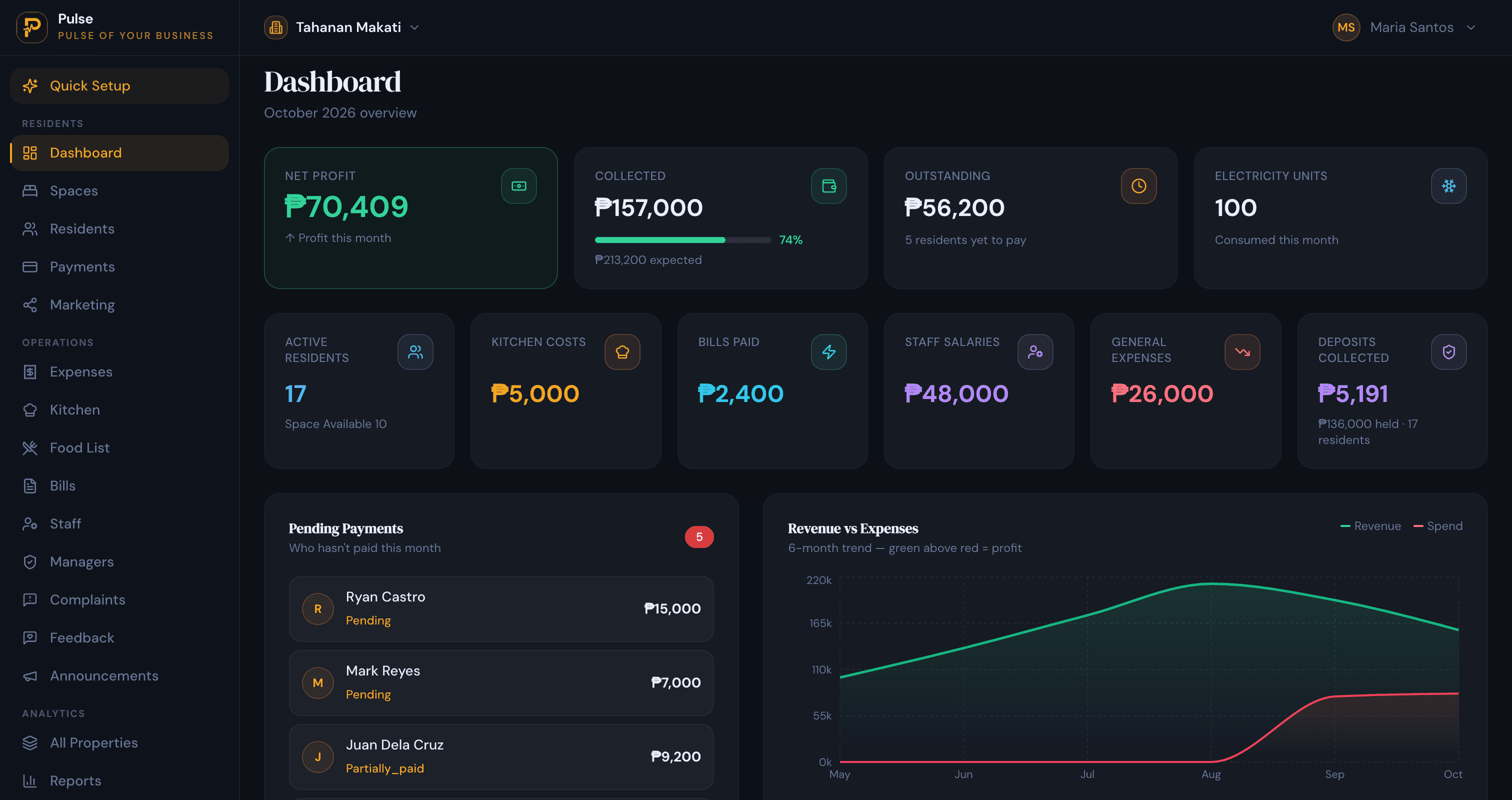
If you run a dormitory, bedspace or boarding house in the Philippines, the software you need is built for letting by the bed and the month, not by the night. That one distinction splits the market in two, and it is the fastest way to avoid paying for a hotel system you will not use. This guide groups the real options honestly, with prices where they are public, and is clear about where PulseHub fits and where it does not.
A quick note on honesty, because comparisons are usually written by whoever is selling. We make PulseHub, so treat our view as a view. But the facts below, who each tool is built for and what it costs, are drawn from each vendor’s own pricing and product pages, and we have tried to be fair to every option, including the free one and the ones priced the same as us.
First, know which half of the market you are in
The single most useful thing to get right is the letting model, because it decides which tools are even relevant.
- Monthly, by the bed. Tenants stay for months, each pays their own rent, you split utilities and track deposits and arrears. This is dormitory, bedspace and boarding-house operation, and it needs bed-level monthly software.
- Nightly, by the channel. Guests book for a few nights, you run a front desk and distribute rooms to Booking.com, Agoda and Airbnb. This is hotel and backpacker-hostel operation, and it needs a hotel PMS with a channel manager.
Plenty of operators are squarely in the first group but end up looking at the second, because the nightly tools market harder. If your tenants pay monthly, the channel features are cost you will not use. Everything below is grouped by this split.
Built for monthly bedspace and dormitories
PulseHub
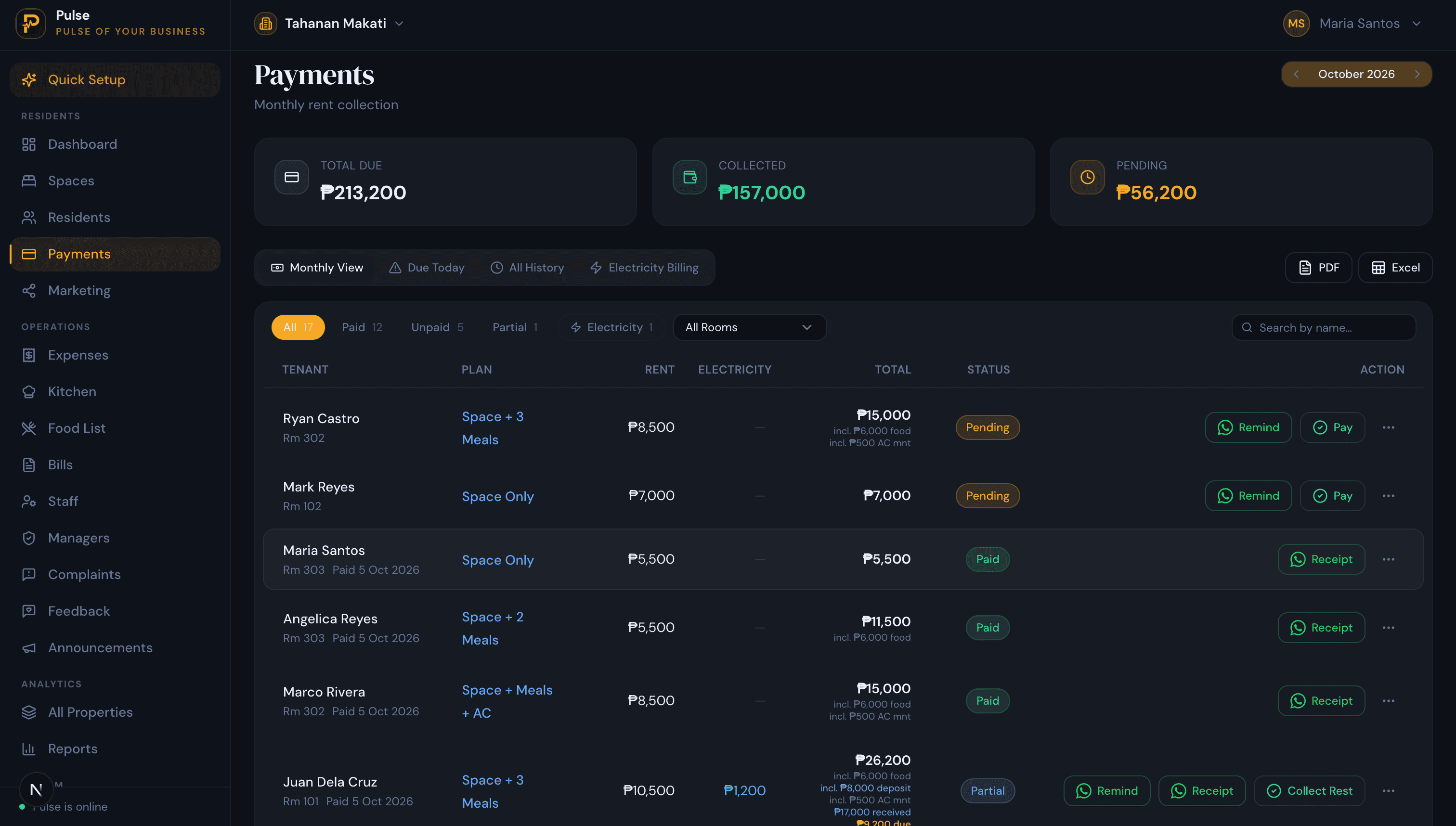
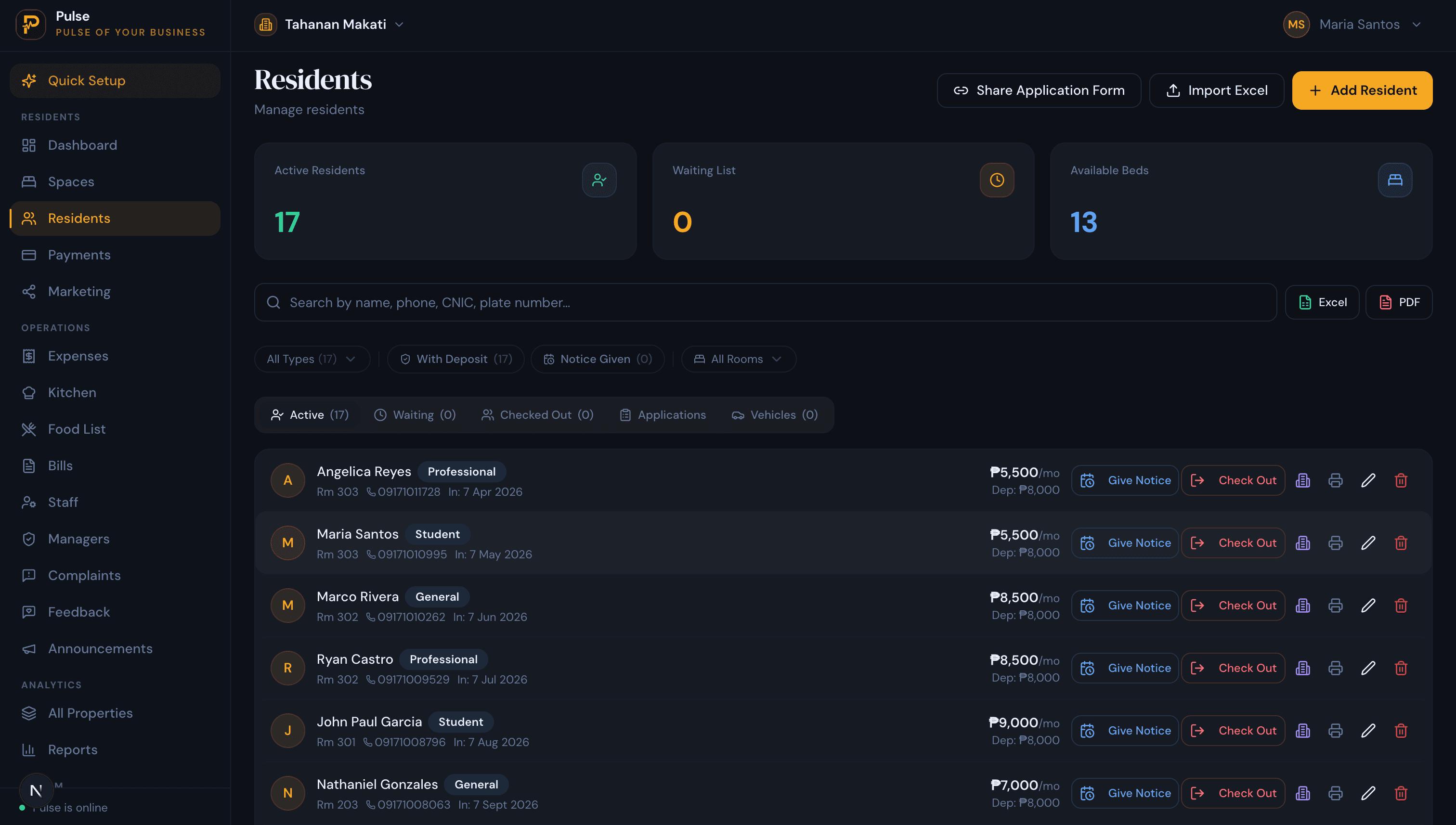
PulseHub is an accommodation management platform for operators who let by the room and the bed. It organises each property into rooms and beds, keeps occupancy true, and gives every tenant one record and one bill, with part-payments recorded as installments. Metered electricity is split between tenants by a reading and their join dates, deposits and arrears are tracked, and every property sits in one portfolio view, with a free public page per property to fill beds. Plans run from about US$29 a month for one property to US$79 for up to ten, with the Philippine portal showing pesos for your tenant billing.
Its honest boundaries: PulseHub records payments and issues receipts, but it is not a payment gateway and does not process GCash, Maya or cards, and it is not a booking channel. Its clearest differences from the local tools are multi-market reach and the precision of the metered-utility split. See PulseHub for the Philippines and our dormitory and bedspace operator guide.
Collo
Collo is a Philippine property management platform aimed squarely at dormitories, bedspace rentals and boarding houses. By its own pages it tracks occupancy per bed, splits shared utilities, handles digital contracts, and, notably, collects rent through GCash and Maya, with a free tenant app. Pricing starts at around ₱5,000 a month depending on portfolio and features. If automated local payment collection is at the top of your list, Collo is the most direct fit of the group; it is Philippine-only, where PulseHub is multi-market and lower at entry.
Smapey
Smapey, based in Cagayan de Oro, offers a free boarding-house management plan for Philippine operators. It covers rooms and beds, tenant ledgers, rent and utility bills, transfers and QR-code maintenance reporting, counting occupancy by the bed. For a single property on a tight budget, free is hard to argue with. The trade is depth and reach: it is a lighter, Philippine-only tool from a small team, so weigh it against how much portfolio reporting, multi-property control and support you need as you grow.
Built for nightly stays and OTA channels
These are capable systems, but they are built for hotels and backpacker hostels that sell by the night and distribute to booking sites. For a monthly bedspace operator they tend to cost more and carry features you will not use.
Cloudbeds
Cloudbeds is a well-known cloud hotel and hostel PMS with a built-in channel manager for Booking.com, Agoda, Airbnb and the rest. Pricing is quote-based and, by third-party estimates, commonly runs into the hundreds of US dollars a month, with onboarding fees on top. It is powerful for nightly distribution; for a monthly dormitory it is expensive and aimed at a different job.
eZee Absolute
eZee Absolute is a hotel PMS, often priced per room, with OTA distribution and front-desk tooling. Like Cloudbeds, it suits nightly operations and multi-channel selling. A monthly bedspace operator pays for a hotel feature set that does not match how they let.
Mangobeds and BedBooking
Mangobeds is a booking engine for hostels and co-livings, starting around US$29 a month with no booking commission; it leans toward reservations and direct bookings rather than monthly tenant ledgers. BedBooking is a low-cost mobile PMS for small, nightly short-stay properties that pushes rates to Airbnb and Booking.com. Both are reasonable for nightly letting; neither is built for monthly bed-level billing and utility splitting.
Price at a glance (verify current rates with each vendor)
Free: Smapey. From about US$29 a month: PulseHub and Mangobeds. From around ₱5,000 a month: Collo. Low-cost nightly: BedBooking. Far higher, quote-based: Cloudbeds (hundreds of US dollars a month plus onboarding) and eZee Absolute (per room). Prices are from each vendor’s public pages and third-party listings and change often.
How to choose
- Start with your letting model. Monthly and by the bed points to PulseHub, Collo or Smapey; nightly and by the channel points to the hotel systems.
- Decide how much local payment automation you need. If GCash and Maya collection is essential, Collo integrates it; PulseHub records payments while you collect your own way.
- Count your properties. One small property on a budget suits a free or entry plan; a growing portfolio rewards real multi-property reporting and scoped manager access.
- Check the real cost. A quote-based hotel PMS can be many times the price of a bed-level tool once onboarding is in; match the spend to the job.
- Look past one market. If you operate, or plan to, outside the Philippines too, a multi-market system saves running two tools.
Where PulseHub fits
PulseHub is the affordable, purpose-built option for monthly bedspace and dormitory operators who want bed-level billing, fair utility splits, deposits and arrears, and one view across every property, without the cost or complexity of a hotel PMS. It is a fraction of the price of the quote-based nightly systems, competitive with the local tools, and it works across markets. It will not collect GCash or Maya for you, and it is not a booking channel; what it does is run the monthly operation and keep the money straight. Start with PulseHub for the Philippines, or read the dormitory and bedspace operator guide and what a property management system is.
In short
There is no single best tool, only the best fit for how you let. For monthly bedspace and dormitories in the Philippines, compare PulseHub, Collo and Smapey; for nightly, OTA-driven stays, look at Cloudbeds, eZee, Mangobeds or BedBooking. PulseHub’s case is affordable, multi-market, bed-level operations with honest payment recording, a long way below the cost of the hotel systems.